

Connector Requirements Evolving with Robot System Architectures
In recent years, the robotics industry has been evolving from traditional automated equipment toward intelligent embodied systems. As robot architectures become more sophisticated—with increasingly complex control systems, denser sensing networks, and real-time data interactions—the internal interconnection infrastructure must evolve accordingly.
As the critical medium for power delivery, signal transmission, and high-speed data communication, connectors play an increasingly important role in robotic systems. Changes in connector design and selection closely reflect the evolution of robot architectures themselves.
From cobots to humanoid robots, internal interconnect requirements continue to evolve
Industrial Robotics: Reliability as the Primary Requirement
Traditional industrial robots are widely used in fixed-operation scenarios such as welding, material handling, assembly, and painting.
Typical characteristics of these systems include:
- Predefined motion trajectories with limited dynamic variation
- Relatively controlled operating environments
- Mature modular architectures
As a result, connector requirements during this stage are relatively straightforward:
- High reliability
- Vibration resistance
- Long service life
- Stable electrical contact performance
In industrial robot systems, connectors primarily function as fundamental power and signal transmission channels. Long-term operational stability is prioritized over high-density integration or high-speed data transmission capabilities.
Collaborative Robots: Miniaturization and Multifunction Integration
With the rapid adoption of human-robot collaboration, collaborative robots (cobots) place greater emphasis on flexibility, safety, and compact system design. Internal integration levels have increased significantly, creating new demands for connector technologies.
1. Increasing Space Constraints
Cobot joints often integrate motors, drivers, encoders, and multiple sensors within highly compact assemblies.
Connectors must therefore provide:
- Higher wiring density
- Smaller footprint
- Improved assembly efficiency
Compact interconnect solutions featuring fine-pitch and low-profile designs have become increasingly important.
2. Higher Dynamic Operating Frequencies
Collaborative robots operate with frequent motion cycles, exposing internal components to continuous micro-vibrations and cyclic mechanical stresses.
Connector systems must offer:
- Enhanced micro-vibration resistance
- Stable contact structures
- Long-term mating durability and fatigue resistance
3. Growing Signal Complexity
The introduction of force control, safety monitoring, and machine vision technologies has significantly increased the number of data channels within robotic systems.
As a result, connectors have evolved from simple power interfaces into integrated interconnection nodes carrying:Power + Control Signals + Sensor Data.
Humanoid Robots: Entering the Era of High-Density Neural Networks
If collaborative robots represent a system integration upgrade, humanoid robots represent a fundamental architectural transformation.
A typical humanoid robot incorporates:
- Multi-degree-of-freedom joint systems
- Numerous servo drive units
- Multi-modal sensors (vision, force sensing, IMU, etc.)
- Edge computing and AI control modules
Its internal interconnection architecture exhibits two major characteristics.
1. Dramatically Increased Data Bandwidth Requirements
Real-time vision processing, motion control, and environmental perception are tightly coupled, resulting in increasingly demanding internal data communication networks.
High-speed differential signaling and low-loss transmission have become critical design considerations.
2. Extreme Space Optimization
Areas such as shoulders, joints, wrists, and hands feature highly integrated mechanical structures with very limited routing space.
Connectors must simultaneously provide:
- Higher density
- Smaller dimensions
- Greater assembly tolerance compensation
- Stronger vibration resistance
At this stage, connectors are no longer simple connection components; they become distributed interconnection nodes that support the entire robotic system architecture.
A System-Level Perspective on Connector Selection
From a robotic system design perspective, internal interconnect architectures can generally be categorized into three major types.
1. Wire-to-Board Connectors
Wire-to-board solutions are widely used in joint modules, motor drives, and sensor connections.
Fine-pitch connector systems, such as 1.00 mm pitch wafer connectors, are particularly suitable for compact drive and control modules where installation space is limited.
2. Board-to-Board Connectors
Board-to-board connectors are commonly deployed between main control boards and functional modules for high-speed data transmission and structural interconnection.
In highly dynamic robotic systems, floating connector designs help absorb assembly tolerances and operational vibrations, significantly improving long-term reliability.
Floating high-speed board-to-board connector solutions are particularly suitable for motherboard-to-daughterboard architectures within robot control systems.
3. Wire-to-Wire Connectors
Wire-to-wire connectors are primarily used for power distribution and module-to-module interconnections.
In demanding industrial environments, sealing performance and connection reliability become key considerations.
Compact connector solutions with ingress protection capabilities can effectively support both space-constrained robotic systems and harsh operating conditions.
In addition, external robot interfaces continue to rely on standardized connectors such as RJ45 and USB for communication, networking, and system expansion functions.
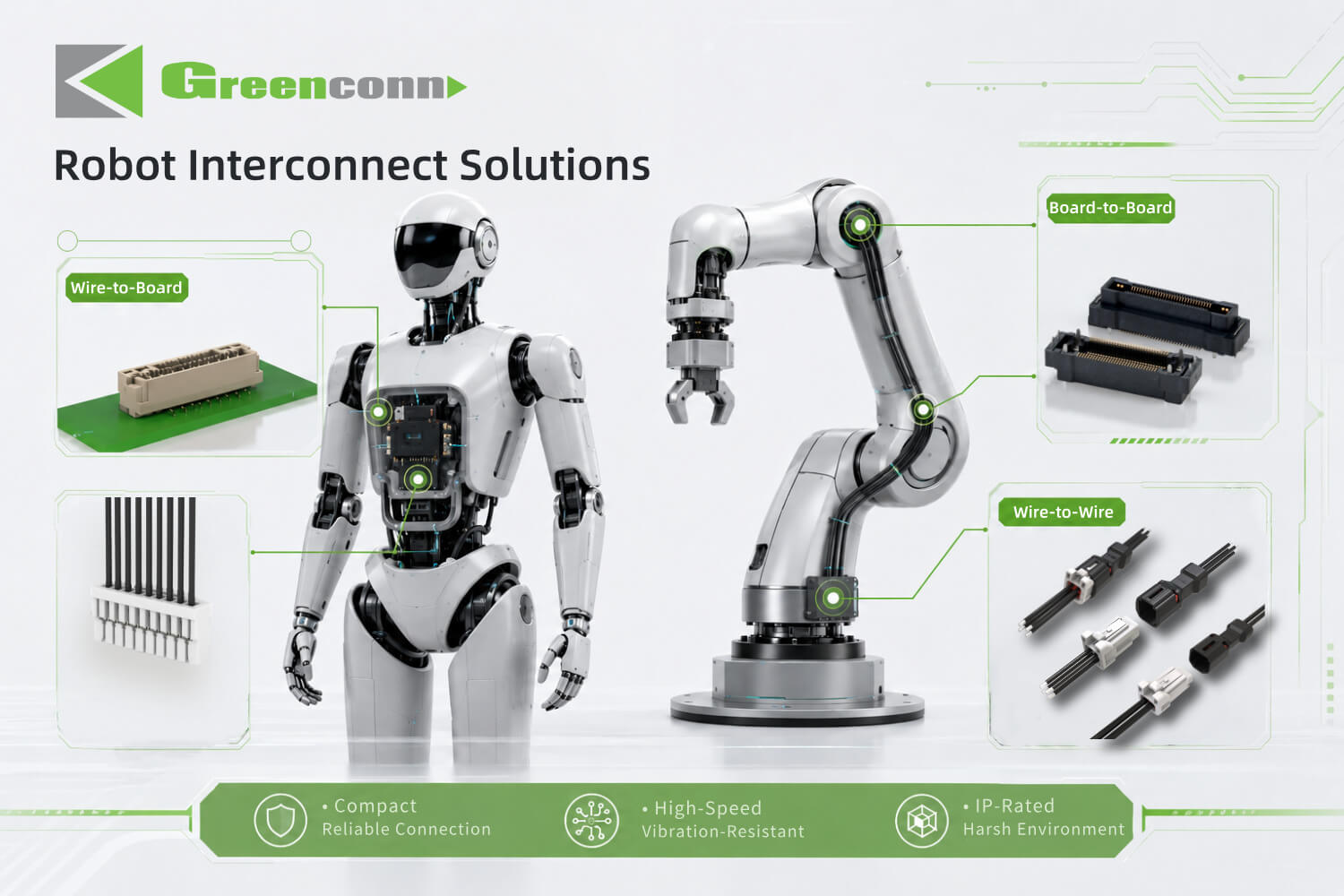
Greenconn robotics connector portfolio
Conclusion
As robots continue to evolve toward higher levels of integration, enhanced perception capabilities, and greater motion freedom, internal interconnection architectures are becoming increasingly sophisticated.
Connectors are transitioning from traditional power and signal transmission components to critical enablers of high-speed data communication, multi-system connectivity, and complex spatial integration.
For next-generation robotic systems, connector solutions featuring miniaturization, high density, high-speed transmission, and superior reliability will form the foundation for stable operation, intelligent interaction, and efficient system collaboration.

